

POLAND (IMB) – For Mateusz Kowalski*, a Polish believer, Lent and the Easter holiday changed meaning when he gave Christ lordship over his life more than ten years ago.
Kowalski is a member of Biblia i Misja, one of five Baptist churches in Kraków, Poland, a city of 750 thousand. An overwhelming majority of the country identifies with Roman Catholicism.
Poles consider Easter their oldest and most important holiday, with traditions dating back to the 10th century.
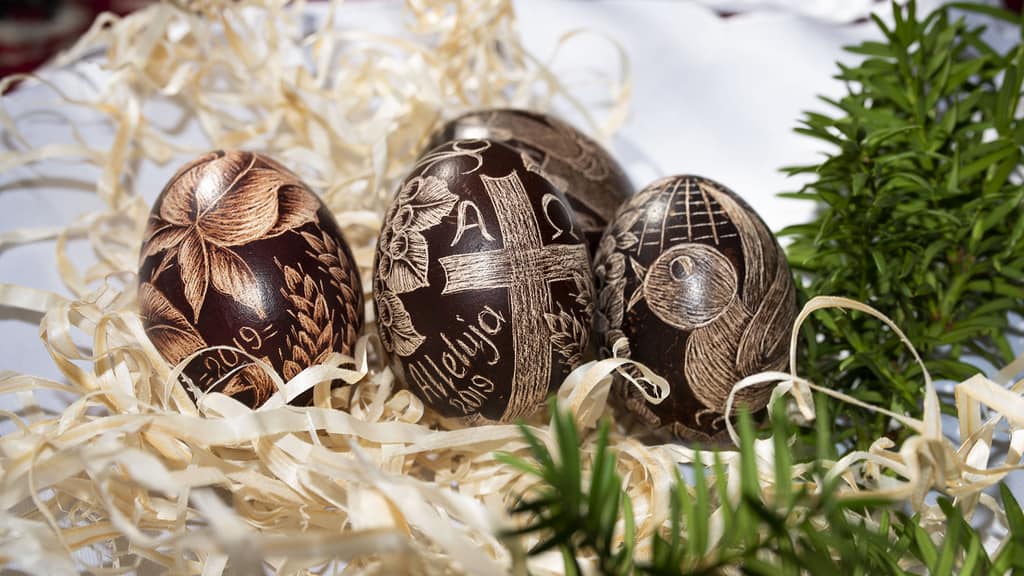
“The eggs are called pisanki,” said Mateusz Hanus about the decorated eggs Poles prepare for Easter. “The name comes from the word for writing—but we draw on them and these eggs symbolize new life.”
The holiday is steeped in famous and beloved Easter traditions, including Easter baskets and decorated eggs. These differ from American traditions in many ways. The eggs, called “pisanki” and symbolizing new life, are dyed more naturally with brown outer onion skin or walnut shells. They are then ornately decorated.
The baskets, called “święconka” baskets, are filled with food, usually signifying the end of the Lenten fast. They’re stocked with things like eggs, bread, sausage (or “kiełbasa”), ham, horseradish, butter and salt.
These baskets are prepared for Holy Saturday—between Good Friday and Easter Sunday. Roman Catholic families in Poland take them to church for a blessing which sanctifies the food for the family’s holiday meal. Devout Catholics have refrained from eating meat—especially on Fridays—during the Lenten fast, so the meal blessed by the priest is seen as a traditional way of breaking their fast. These baskets establish the Easter meal as a more holy meal.
Several Eastern European countries share similar Easter basket traditions.
Despite all the Roman Catholic tradition around it, Polish believers see the significance of the holiday and its Polish name “Wielkanoc.”
“Before I got saved Lent and Easter were like a schedule, you know,” said Kowalski. “I knew that it was about Jesus, that He rose from the grave, but before I was saved, I felt this in some way, but it wasn’t in full.”
Kowalski likens this feeling to 2 Corinthians 3:14 when Paul describes a veil over the eyes of the Jews that was only taken away through Christ. “I knew everything about the holiday and maybe even in some way I felt it and I knew that it was connected to me, but it was like it was covered and hidden for me.”
He continued, “When for the first time I told Jesus, ‘I give you my life, take over control of my life,’ it was in a Catholic church preparing for Lent and Easter. I remember it was when I was 16, maybe 17. Before, the holiday had been for many years like a process. But when I got saved the holiday definitely changed. Now Easter is like a great time of joy.”
Kowalski and his wife, Kasia, hope that their two boys will grow up knowing these traditions which have been part of Polish life for centuries. But Kowalski sees that his Catholic family takes the traditions more seriously than they should.
Kowalski plans to one day show the traditions to his boys, but he plans to teach them that the blessing of God is in the provision of every meal and that every day in Christ is a joyous celebration of our salvation.
“Every year it’s a great reminder that the salvation I have through Jesus, from God, it’s really special and unique; not everyone has it. When I talk with my friends, they often don’t know what I’m talking about because in Poland, Catholics celebrate differently,” Ola Skowrońska*, a youth leader at the church, added.
For most of Poland, the resurrection of Christ remains a tradition. The beauty and joy are hidden behind layers of tradition that blind their eyes to the true joy to be found in a personal relationship with Jesus Christ. Our prayer is that Poles, and Catholics around the world, would also see the joy to be found in Christ, please pray with us:
- That the schedule, tradition and process, of the Catholic Church would no longer hide how to have a personal relationship with Christ.
- That the small Baptist churches in Kraków, and their members, would be able to use holiday traditions as a means to share Christ with their friends and families.
*Names changed for security
Kelvin Joseph* is a contributing writer and photographer for the IMB, serving in Poland.