

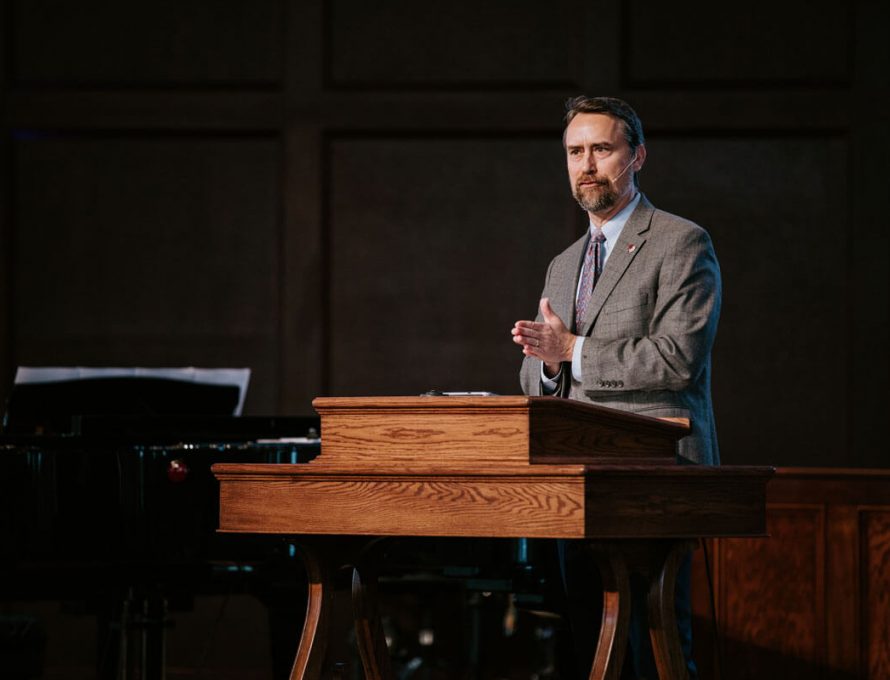
KANSAS CITY (BP) – New Testament and canonical scholar Michael Kruger delivered Midwestern Seminary’s annual Sizemore Lectures on Feb. 25-26, exploring the topic of “Were the Church Fathers Inspired in the Same Way as Scripture?” when selecting the biblical canon.
Kruger, who serves as president and the Samuel C. Patterson professor of New Testament and early Christianity at Reformed Theological Seminary’s Charlotte campus, focused his two-lecture series on the questions: “Were the church fathers inspired in the same way as Scripture?” and “How did early Christian identify inspired books?”
Kruger responded to a number of scholars who claim that the early fathers saw nothing distinctive about the New Testament writings as compared to writings being produced in their own time period.
Ultimately, Kruger found this view problematic and said that the early church fathers accepted some books of the canon because they were inspired and rejected other books because they were not.
Kruger explained that several pieces of evidence exist that suggest church fathers used inspiration language in different ways – some of which was applicable to Scripture, and some of which was applicable to lower or lesser authorities.
First, such evidence included that some church fathers used inspiration language even when referring to pagan writers like Plato. Second, many supposed examples of the church fathers’ use of inspiration are instances where a writer simply acknowledges how the Spirit is working within the church. Third, some church fathers may have considered some of these “extrabiblical” books to be inspired like Scripture.
Of this, Kruger explained, “Thus, they didn’t have a wider view of inspiration, just a wider view of the canon.”
Fourth, early Christian sources viewed the apostles as speaking with a distinctive divine authority on par with the OT prophets. Thus, there is a higher form of inspiration that superseded the church fathers. And fifth, a number of patristic writers expressly differentiated levels of inspiration.
In his second lecture, Kruger explored ways to determine whether early church fathers possessed a distinctive way to identify biblical books as inspired, and is it still possible to do so today?
Kruger stated that early Christians believed apostolic books were self-authenticating, which meant they possessed certain qualities that revealed their divine character.
“It’s not so much that books claim to be divine, although some do,” Kruger said, “But they evidence themselves to be divine by their internal qualities.”
Such qualities, Kruger suggested, are the beauty and excellency of Scripture, the power of Scripture, and the unity of Scripture.
The church fathers, Kruger said, “were always quickly able to point out if a book was not from God by simply pointing out how it made errors, how it had mistakes, and how it contradicted prior revelation. This is how the church fathers beat back the apocryphal gospels, as they would often show this was the case. So, this is a fascinating aspect here, that what you have is now a third quality that shows indeed this unity and harmony is a marker of God’s own divine authorship.”
Kruger added that, to understand Scripture as inspired, one must rely on the help of the Holy Spirit.
“The natural man does not receive the things of the Spirit,” Kruger explained. “If you’re going to observe divine qualities of the Spirit, then you have to have the Spirit (within you) to observe those divine qualities correctly. So, what the fathers would argue is: that through the fall and through the training of sin, men cannot apprehend rightly what the Scripture actually is.
“In other words, to put it differently, when people don’t recognize the Bible as the Word of God, the problem isn’t the Bible. The problem is their ability to perceive…. It’s almost like the non-Christian is spiritually tone deaf.”
Kruger concluded by emphasizing that the best way for one to acknowledge the self-authenticating nature of inspired biblical text, and to come into a belief of its precepts, is “simply by reading it and hearing it.”
To view the lecture series, visit https://www.mbts.edu/2020/02/chapel-with-dr-michael-kruger-sizemore-lectures/.