

NASHVILLE (BP) – Most older Americans say right and wrong never change. Younger Americans — not so much, according to a new study released today (May 9).
The study by LifeWay Research found a significant generation gap in how Americans view morality. More than 6 in 10 of those older than 45 say right and wrong do not change. For those 35 and younger, fewer than 4 in 10 make that claim, according to the study that was conducted Sept. 2–Oct. 1, 2016.
That’s a huge shift between generations, said Scott McConnell, executive director of LifeWay Research.
“We are shifting very fast from a world where right and wrong didn’t change to a world where right and wrong are relative,” McConnell said. “We are not all on the same page when it comes to morality. And we haven’t reckoned with what that means.”
LifeWay Research’s representative survey of 1,000 Americans found most worry moral behavior is on the decline.
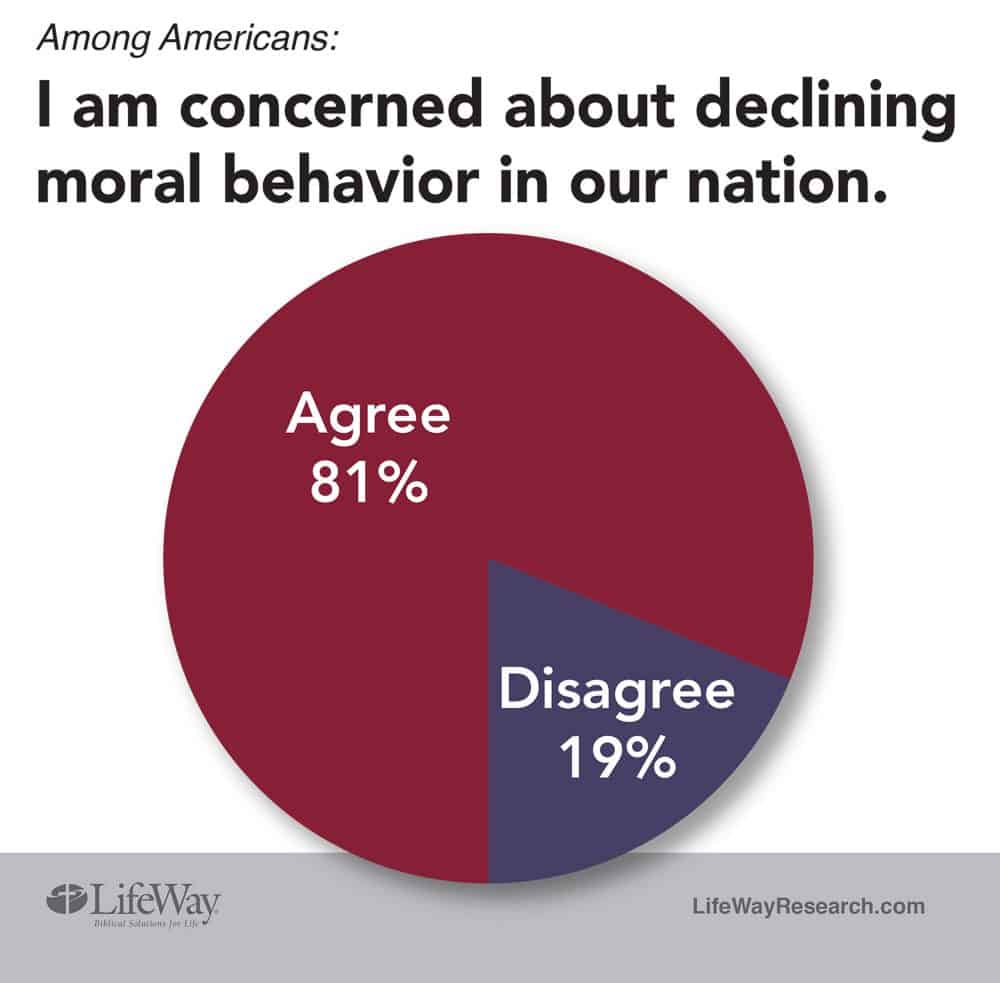
Researchers found 81 percent of Americans agree with the statement, “I am concerned about declining moral behavior in our nation.” Nineteen percent disagree.
Worry about morals differs across demographic lines, but remains consistently high. Most Americans older than 65 (85 percent) are concerned about declining moral behavior, as are those 18 to 24 (71 percent.) Those with graduate degrees (72 percent) agree, as do those with a high school degree or less (85 percent). So do Christians (85 percent), those of non-Christian faiths (70 percent) and “nones” – those with no religious affiliation (72 percent). White Americans (82 percent), African-Americans (86 percent), Hispanic Americans (73 percent) and Americans of other ethnicities (75 percent) agree as well.
Yet Americans disagree over whether morality can be legislated.
Almost two-thirds (63 percent) agree with the statement, “Implementing laws to encourage people to act morally is not effective.” Thirty-seven percent disagree.
On the other hand, fewer than half (44 percent) agree with the statement, “The fewer laws regulating moral standards, the better.” Fifty-six percent disagree. Men (49 percent) are more likely to agree than women (39 percent). Nones (55 percent) are more likely to agree than Christians (39 percent.) Those who attend religious services less than once a month (48 percent) are more likely to agree than those who attend at least once a month (36 percent).
Half of Americans (51 percent) also think too many laws about moral standards have been removed. About half (49 percent) disagree. Those with evangelical beliefs (72 percent) are more likely to agree than Americans who don’t hold evangelical beliefs (46 percent). Christians (55 percent) are more likely to agree than those of other faiths (36 percent) or nones (42 percent).
LifeWay Research looked at the factors that shape the shared moral views Americans think society should hold.
Researchers asked the question two ways. First, they gave Americans a list of potential factors and asked them to select as many as applied. Among those influences: parents (64 percent), religious beliefs (50 percent), personal feelings (42 percent), friends (35 percent), teachers (26 percent) and media like books, movies and music (14 percent).
When asked which of those factors are most influential in shaping their moral views, Americans name their parents (39 percent), followed by their religious beliefs (26 percent) and their feelings (18 percent). Friends (4 percent), teachers (2 percent) and media (3 percent) are less influential.